
As the resident organist at St Peter’s I suppose it was inevitable that I was ‘invited’ to write the review for this concert and I was looking forward to hearing Andrew Lumsden, who I knew from reputation was a great performer and well known as the popular director of music at Winchester Cathedral for many years.
what can I add?
Looking at the excellent programme notes I wasn’t sure what I could add to them, as they gave interesting and detailed notes about each piece and a useful glossary of organ terms for those unacquainted with the instrument. I suspect most of the people reading this will already have digested them so what can I add?
ok, got an idea NOW…
Well, it was a really good programme. For those who might not think they were that keen on organ music it was an education in just how vast the range of music is for the “King of Instruments” and for those who play (and there were a few organists in the hall) it was fascinating to see how Andrew would interpret some well-known pieces. For on an organ, not only does the player make stylistic choices as, say a pianist would when interpreting Bach or Lizst (just how much rubato for Chopin? Etc.), but as nearly every organ is different there is also the fascination of how the player will choose to register a piece. What stops are available to him or her to use on this particular machine? How will he or she utilise them?
“What I don’t understand is why he isn’t doing it on the Victorian organ? We just raised a fortune to have ours restored. Surely a real one is better?”
There was some discussion in the room about the decision to bring in a 3 manual Viscount digital organ rather than using the existing Victorian tracker action organ that we use regularly for our services. A very good question, and one that I think was answered by Andrew Lumsden’s choices. Reader, read on!
For one thing, his pieces ranged from across Europe. Our organ at St Peter’s is a very decent example of an English organ. It has a limited but good range of typically British stops, including diapasons and flutes on the great, and reeds on the swell. It supports hymns singing on a Sunday with gusto, stirring the congregation and choir to sing lustily or gently creating a soothing atmosphere during Communion. It does Bach really well and also supports most of our great English choral repertoire adequately, although not with great subtlety. It is a very good instrument for a parish church, a fantastic ‘workhorse’ but it is not, and does not pretend to be, a cathedral organ.
audio tour of Europe
The organ we heard at this recital contained the recorded sounds of many great cathedral organs and that technology transported us aurally to France, Holland, Germany and Westminster Abbey.
There is often heated debate about whether or not churches should go digital or pay for the upkeep of their existing organs. I’m not getting into that here, but there are some truly awful, aging electronic organs around that to my mind add nothing to the experience of worship and are hugely inferior to some of the beautiful antique tracker action organs that have survived the test of time. However, at the other end of the scale we can now enjoy the advances in technology that a really excellent digital and programable instrument can bring in 2026. It’s not even just the sound, but the way, with well adjusted speakers, the whole body resonates as the pedal notes growl away. To be honest, that made this organ very close to the experience of listening to a Cavaille-Coll instrument built to fit St Sulpice or similar great church.
The opening number was Gigout’s ‘Grand Choeur Dialogue’, which opened with a fanfare on the manuals (keyboards played by the hands) and then was joined with a fanfare in the pedals (keyboard played by the feet). Andrew played with masterful confidence, utilising contrasting stops to create a musical ‘conversation’.
At the end he explained how, on a ‘real’ French cathedral organ the trumpet sounds would have come from the opposite end of the building to the diapasons and flutes (different kinds of pipes, with different sounds). Sometimes you can see trumpet stops sticking out horizontally, all nice and shiny with ornate decorations around them. That visual drama and actually seeing the pipes that create the noise is one thing we didn’t get from the compact electronic set up, smart though it was. In the golden days of organ building it was common to have different ranks of pipes in different parts of a building and for them to be huge and ornate works of art.
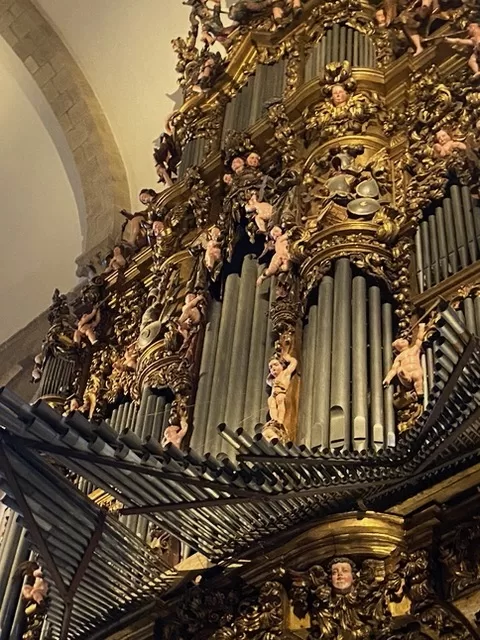
The trumpet pipes at the Catedral de Santiago de Compostela, Spain
However, with the next piece we were thrown back 300 years to Holland. Now Andrew chose ‘the most Dutch sounding stops I could find’ to recreate the sound of a Sweelinck Variation on Unter Linden Grüne’. Suddenly we were aurally transported back in time, to a different country and to a simpler building.
This gentle, melodious piece was played entirely on the manuals as when Sweelinck (1562-1621) was composing he did not have the luxury of a pedalboard. Interestingly, the Dutch Calvinists forbade the use of organs in church services and Sweelinck was employed instead as a civic organist. This is why the piece has a secular name. It means ‘Under the green lime tree’.
Rural parish organists often find Sweelinck pieces very useful as they can be played on some of the very simple organs in the smallest churches that also do not have a pedalboard. ‘Manuals only’ organ music is often better suited to such instruments than piano music because it is designed for organ pipes. Piano music relies on the player being able to get a crescendo from pressing harder on the keys. On an organ it makes no difference how hard you press a key, the sound is constant. Colour is built from using a combination of different stops and, if you are lucky enough to have one, using a swell pedal. Hence music by an organ composer like Sweelinck can still trump a modern piano composer when it comes to service music!
From a Dutch master to someone who came later within the same organ playing tradition. The supremo organ player and composer, the mighty J S Bach. Coming nearly a hundred years after Sweelinck, and fully in church employ, he had all the latest organ building tech at his hands and feet. Andrew treated us to his Prelude and Fugue in C, BWV 547. The prelude (often a fairly free style piece) was a hurdy-gurdy style dance-like piece, with the pedals playing a rhythmically like a tuba or an elephant engaged in a graceful dance in the bass while the fingers twirled above. I was impressed at how consistent the player’s feet were in their articulation, contrasting with the more legato- style playing of his hands.
In between pieces Andrew gave us some interesting facts about the instrument he was using and this included pointing out the pedal pistons he was using to change his registrations. On the resident organ at St Peter’s we have large draw stops like door knobs that need to be quickly yanked out or pushed in during breathing spots in hymn playing to change registration. It’s all done physically and you have to practise doing this at speed as well as actually playing the notes of the hymn with your fingers and feet.
At a concert played on a gigantic old Cavaille Coll organ in St Sebastian some years ago I enjoyed watching Daniel Roth perform with two of his students working as ‘registrants’ for him, one on either side. It was their job to pull out or push in all the many stops he wanted throughout the show. Quite a responsibility and it required very slick timing and accuracy.
Andrew Lumsden now explained how he had spent a couple of hours planning out all his registration in advance and using the built in computer to log every single change. As he was playing in the concert, he was just using a ‘pedal piston’ to move between each setting. One tap, job done. No need for a team of helpers.
Another area where the hired instrument was technically easier to play than a more traditional one was in its regularity. Early electronic machines often had a horrible touch, with none of the tactile resistance of a tracker action instrument. Newer ones have the best of the tracker action feel but without the heavy lifting weight that they can acquire when two or more keyboards are ‘coupled’ together. They also have the advantage of not wobbling and being more predictable, lending themselves to more expressive articulation. Articulation is the way in which a player strikes or leaves a key. As I said earlier, it doesn’t matter how hard you press a note, it won’t get any louder, so the attack and lift off become particularly important. How legato? How staccato? How detaché? These distinctions can be argued over for hours.
From Bach in Leipzig we were transported back to Paris. As soon as the Durufle Scherzo op 2 began I was reminded of walking through churches in France, where you often hear their very distinctive organ music being played either live or as recorded music to create ambience and a prayerful atmosphere. Andrew described Durufle as occupying the same musical space as Debussy and Ravel. It could hardly have been more different to the Bach, and made full use of the swell pedal , which was an innovation Bach did not have.
If you look carefully at the St Peter’s organ being played you might just be able to see large shutters opening and closing like Venetian blinds. This is the swell box opening and closing and has the effect of creating a gradual crescendo or diminuendo. It is usually operated by the right foot.
The words ‘mysterious’, ‘sublime’ and ‘ethereal’ came to mind as I listened. As the programme notes said, it seemed to ‘shimmer’. Its warm texture relied on some heavenly stops that simply are not available on our own much loved organ, sadly.
And on to music by Frank Bridge, whose Adagio in E I know and love. The soundscape took us back to England at the turn of the 19th to 20th centuries and a golden age of English organ music. Genius piece of writing, full of harmonic subtlety and intensely beautiful but difficult to pull off with its long, slow crescendo passages and sudden contrasting effects. Absolutely loved the way Andrew realised these on the digital organ. There was no doubt that the excellent instrument, with its many stops, couplers and well-balanced swell pedal lent itself brilliantly to achieving these effects, but no piece of tech can really fulfil its potential without a player of great skill and imagination making the most of them.
The Carillon de Westminster from Vierne’s 24 Pièces de Fantasie is not my favourite from that collection but it made a suitably flamboyant end to the first half and its creation story was interesting. It was a collaboration between England and France. Apparently, organ builder Henry Willis hummed the tune of the bells of Westminster to Vierne, who then wrote this piece based on that. Except he didn’t use the exact notes and got the second quarter wrong. Was this deliberate? Was it a mistake? By whom? Anyway by half way through I felt I had got the point. I personally prefer “Arabesque” and “Berceuse” from the series but then I usually do prefer quieter, more gentle music.
Stoked up with drinks and with our numb seats brought back to life by walking about, the audience returned to their seats for the second half eager for more. Many had taken the opportunity to have a good close up look at the instrument with its gazillions of tabs (stops) that resembled the cockpit of an areoplane.
First on the bill was a piece by Widor. Not THE piece, which everyone knows him for. It was interesting to read that Widor liked using the organ as a kind of one player orchestra. Note to self: It’s ok to use lots of different registrations when playing the toccata. There were technical reasons why I felt I should have liked this but actually it didn’t particularly grab me.
Unlike Elgar’s Nimrod, which followed!
From the first few notes my heart was in my mouth. To me this was a relief after the loud Widor. It had calm, beauty, strength and an engaging melody. I loved the way Andrew used the registration to create a sound like a French horn being accompanied by an orchestra. Why is listening to music you know well so lovely? I asked myself.
Then we were back in Paris and everything was different again. Although I didn’t know this particular piece by Messiaen it was another piece that gripped me. It was “Les Bergers” from a collection of pieces about the Nativity. In places the hands are crossed over on different keyboards and the effect is of layers of sounds. It was also a piece of two parts. First a slow, light filled contemplation of the Christ child by the shepherds, as if everything has slowed down for them. Then, as they leave, a flutey conversation starts up as if they are having a happy conversation as they make their way home.
Back across the Channel to hear Thalben-Ball’s rightly famous Elegy. What a gorgeous combo of stops at the end. My ears strained to hear every note and I could feel my pulse slow. Note to self: Must buy this piece!
Finale and encore
What better way to end the official programme than with Walton’s Coronation March: Crown Imperial, arranged for organ by Murril. On a summer day in a traditional church in bucolic Stockbridge we were treated to a performance that could have been in the Royal Albert Hall at the proms. I shut my eyes and feasted on the images it conjured up. It lives and breathes nostalgia, Queen/King and country, national treasures and royal fly pasts, street parties, coronations and weddings, golden coaches, famous BBC commentators, tossing manes, silver breastplates, cavalry guards who have spent the night polishing metal bits and leather boots, crowns, ermine and an AWFUL LOT OF BLING!
Fantastic!
And to cap it all, as an encore we did get THE Widor after all!
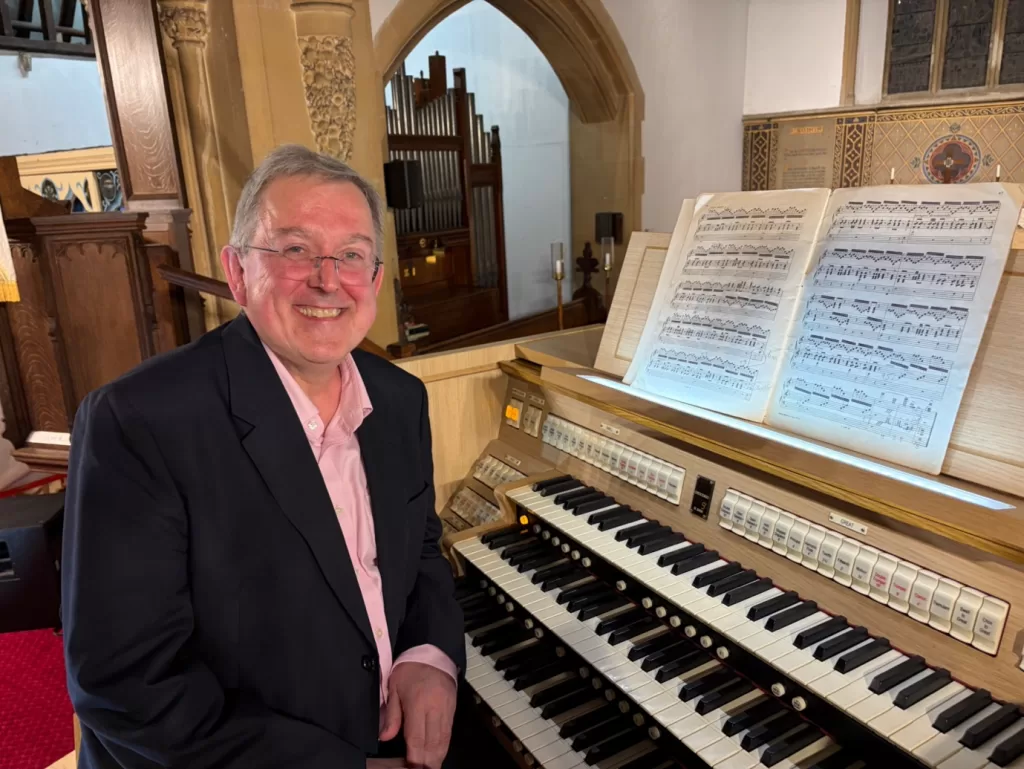
Andrew Lumsden at the Viscount digital organ, with the Victorian organ visible behind